
How to Make Friends with Fear: The F.E.A.R. Framework
如何与恐惧交朋友:F.E.A.R.框架
Growing up, many of us are taught to fight off our fears—to be strong and confident, to cast away our doubts and insecurities. As adults, fear becomes something we feel we have to carry alone, afraid to share it because it might make us seem weak.
成长过程中,我们很多人被教导要战胜恐惧——要坚强自信,要摒弃疑虑和不安。长大后,恐惧却成了我们觉得必须独自承受的东西,我们害怕与人分享,因为那可能会让我们显得软弱。
This is especially true for business leaders. Fear can be perceived as a lack of conviction. But the truth is, trying something new and pushing beyond the familiar is always going to be scary.
对于商业领袖而言,这一点尤其如此。恐惧可能被误解为缺乏信念。但事实是,尝试新事物、突破熟悉的领域总是会让人感到恐惧。
Launching a startup, developing a new product, or stepping into a new market means navigating the unknown. No matter how much we plan, there’s always uncertainty. And that uncertainty brings fear—whether it’s the fear of failing, being judged, or facing rejection.
创办初创公司、开发新产品或进军新市场都意味着要探索未知领域。无论我们计划得多么周全,不确定性始终存在。而这种不确定性会带来恐惧——无论是害怕失败、害怕被评判,还是害怕遭到拒绝。
Fear as a built-in Survival Guide
恐惧作为一种内置的生存指南
When you face something uncertain or threatening, your brain’s amygdala kicks into gear, triggering reactions that prepare you to either fight or flight. In addition to fast-acting neurotransmitters, your brain also uses neuropeptides, which act more slowly but help fine-tune your fear response, making sure you stay aware of potential risks.
当你面对不确定或威胁的事物时,大脑的杏仁核会迅速启动,触发一系列反应,让你做好战斗或逃跑的准备。除了快速起效的神经递质外,大脑还会 利用 神经肽,它们起效较慢,但有助于微调你的恐惧反应,确保你始终意识到潜在的风险。
While this response can feel uncomfortable—heart racing, sweaty palms, tense muscles—it’s actually designed to keep you safe. The heightened awareness helps you react quickly in the face of danger, but it can also be useful in non-life-threatening situations, such as navigating uncertainty in a business decision. In fact, moderate levels of arousal can boost performance by keeping you alert and focused.
这种反应虽然会让人感到不适——心跳加速、手心出汗、肌肉紧张——但实际上是为了保护你的安全。高度的警觉性有助于你在危险面前迅速做出反应,即使在非危及生命的情况下,例如在商业决策中应对不确定性时,它也能发挥作用。事实上, 适度的兴奋状态 可以让你保持警觉和专注,从而提升工作表现。
Fear itself is not bad. It’s a natural response designed to protect you. In fact, as one of our oldest survival mechanisms, it can even be healthy. It can help avoid reckless decisions, heighten our awareness, and fuel our motivation.
恐惧本身并非坏事。它是一种旨在保护我们的自然反应。事实上,作为我们最古老的生存机制之一,它甚至有益于身心健康。恐惧可以帮助我们避免鲁莽行事,提高我们的警觉性,并激发我们的动力。
Yet, we suppress it, leading to its worst effects—overthinking, poor communication, and missed opportunities because we shy away from risks. As a result, we often get all of its drawbacks without any of its benefits: work is slower because of analysis paralysis, communication is unproductive because we hold back information, innovation is scarce because we avoid taking any risks.
然而,我们却压抑这种思维方式,导致其最糟糕的后果——过度思考、沟通不畅,以及因畏惧风险而错失良机。结果,我们往往承受了它所有的弊端,却享受不到它的任何益处:工作效率因分析瘫痪而降低,沟通效率低下因信息隐瞒而降低,创新匮乏因规避风险而减少。
What if instead we embraced fear as a natural part of life, one that’s full of curiosity, experimentation, and creativity? Making friends with fear means recognizing that it’s not something to avoid or ignore, but rather something to treat as helpful information.
如果我们把恐惧视为生活自然的一部分,一种充满好奇心、实验精神和创造力的生活,那会怎样呢?与恐惧交朋友意味着认识到它不是应该回避或忽视的东西,而是应该把它当作有用的信息来对待。
Using the F.E.A.R. Framework
运用 FEAR 框架
Of course, that’s not an easy feat. We’re wired to blindly obey our fear instead of having a friendly conversation, and we haven’t been taught how to communicate our fears in a constructive way. Fortunately, there are simple steps you can practice to welcome your fear and even leverage it. I call it the F.E.A.R Framework:
当然,这并非易事。我们天生倾向于盲目服从恐惧,而不是与之友好沟通,而且我们也没有被教导如何以建设性的方式表达恐惧。幸运的是,有一些简单的步骤可以帮助你接纳恐惧,甚至利用它。我称之为“恐惧框架”:
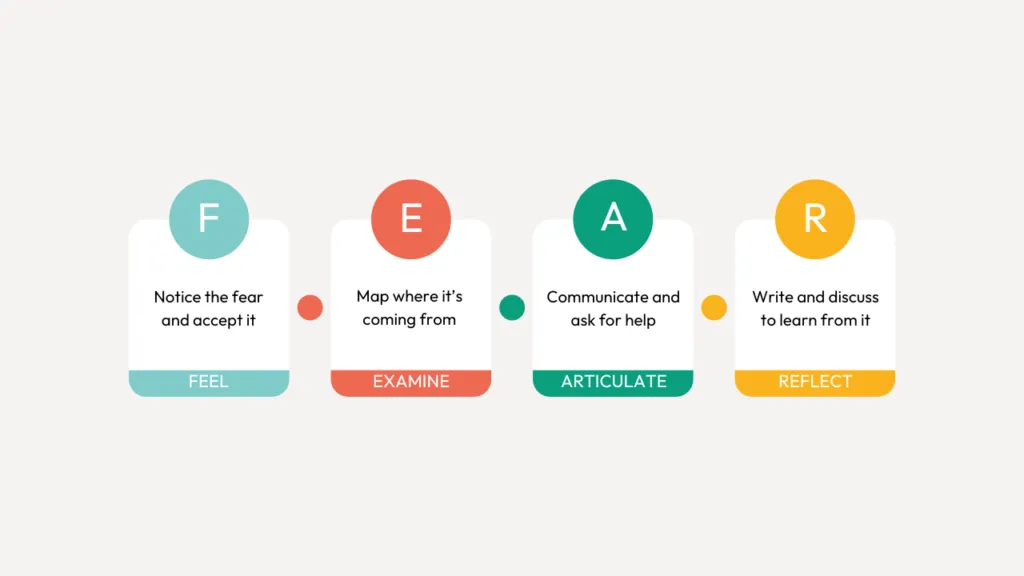
The F.E.A.R. Framework for Making Friends with Fear 恐惧交朋友的 FEAR 框架
1. Feel your fear. Your stress response to a perceived threat has an immediate physiological impact. Your heart beats faster, your breathing speeds up, your blood thickens, your skin produces more sweat. Rather than ignoring these signs, notice and accept them as a natural part of facing the unknown. A few deep breaths or simple stretches can help feel our fear without experiencing additional anxiety.
1.感受你的恐惧。 你对感知到的威胁所作出的压力反应会立即产生生理影响。你的心跳加快,呼吸急促,血液变得粘稠,皮肤出汗增多。不要忽视这些信号,而是要觉察并接受它们,将它们视为面对未知事物时自然而然的一部分。几次深呼吸或 简单的伸展运动 可以帮助我们感受恐惧,而不会加剧焦虑。
2. Examine the source of your fear. Once you’ve acknowledged your fear, take the time to understand where it’s coming from. Fear can stem from tight deadlines, financial pressures, or uncertainty about a project’s outcome. Using a metacognitive tool like mind mapping can help pinpoint the source of your fear. Engaging in this type of analysis can activate the prefrontal cortex, a higher-order part of your brain, which can then help you manage fear more effectively.
2. 探究恐惧的根源。 一旦你意识到自己有恐惧,就要花时间去了解它的来源。恐惧可能源于紧迫的截止日期、经济压力或对项目结果的不确定性。使用思维导图等元 认知工具 可以帮助你精准定位恐惧的根源。进行这类分析可以 激活 大脑前额叶皮层——大脑中负责高级认知功能的区域,从而帮助你更有效地应对恐惧。
3. Articulate your needs. This step might be the hardest, as it requires radical vulnerability: sharing your fears with the people who matter and openly asking for help—whether that’s extra support on a project, coaching for public speaking, or mentorship to navigate a tricky situation. Sharing your fear doesn’t make you weak; it makes you agentic. And often, by simply voicing your concerns, you can find solutions that will help alleviate them.
3. 明确表达你的需求。 这一步或许是最难的,因为它需要你彻底敞开心扉:向重要的人倾诉你的恐惧,并坦诚地寻求帮助——无论是项目上的额外支持、公开演讲方面的指导,还是应对棘手情况的导师。分享你的恐惧并不会让你显得软弱,反而会让你更有主见。而且通常情况下,仅仅表达你的担忧,就能找到缓解这些担忧的解决方案。
4. Reflect on your experience. Finally, take the time to learn from the experience. Everyone is different, and so are our responses to fear and our coping mechanisms. How did acknowledging and sharing your fear impact the situation? What strategies worked best for managing it? How might you make friends with your fear quicker in the future? Journaling about your experience or discussing it with others can help you prepare for future challenges.
4. 反思你的经历。 最后,花些时间从这次经历中学习。每个人都不同,我们对恐惧的反应和应对机制也各不相同。承认并分享你的恐惧对当时的情况产生了怎样的影响?哪些策略最有效?将来你如何才能更快地战胜恐惧?将你的经历 写成日记 或与他人讨论,可以帮助你为未来的挑战做好准备。
Making friends with our fears means exploring our inner world and opening up to others, being vulnerable in the face of distress, and building collective resilience by leading the way in sharing our concerns.
与恐惧和解意味着探索我们的内心世界,向他人敞开心扉,在困境面前展现脆弱的一面,并通过率先分享我们的担忧来建立集体韧性。
When you stop running from fear and start working with it, amazing things can happen. By feeling your fear, examining its source, articulating your needs, and reflecting on the experience, you can transform this natural response into a powerful driver of personal and professional progress.
当你不再逃避恐惧,而是开始与恐惧共处时,奇迹就会发生。通过感受恐惧、探究其根源、表达需求并反思这段经历,你可以将这种自然反应转化为推动个人和职业发展的强大动力。
As a leader, creating a space for these conversations fosters psychological safety, encouraging people to learn, reflect, and grow together through challenges. It’s not easy, but it’s worth the effort to build a safer, more courageous world—one where boldness is encouraged and vulnerability is celebrated.
作为领导者,营造这样的对话空间有助于建立 心理安全感 ,鼓励人们在挑战中共同学习、反思和成长。这并非易事,但为了构建一个更安全、更勇敢的世界——一个鼓励大胆、赞美脆弱的世界——付出努力是值得的。
This post is adapted from an article originally published in PRESENT MAGAZINE, VOL. 2. VULNERABILITY (2021).
本文改编自 PRESENT MAGAZINE 第 2 卷《脆弱性》(2021 年)上发表的一篇文章。